If you've been in the mutual fund business for a few years, you've probably seen this happen more than once.
A client starts investing through a SIP. You help them stay invested during market corrections, answer their questions, and guide them through different life stages. Over time, the portfolio grows.
Then one day the conversation changes. Instead of asking which fund to choose, the client begins to ask whether there are investment options beyond regular mutual funds.
That is usually a sign that the investor has become more experienced and wants to explore new opportunities.
Specialised Investment Funds (SIFs) may help you address these conversations.
Before you begin discussing Specialised Investment Funds (SIFs) with clients, it is important to understand both the qualification requirements and the SIFs themselves.
You need to pass the NISM Series XIII: Common Derivatives Certification Examination to distribute SIFs. This exam will help you to understand:
Besides the compliance requirement, the certification also gives you a toolset to confidently respond to investor enquiries.
Giving investors and HNI clients clear, logical, and data-backed guidance is extremely important.
First of all, you must understand thoroughly the place of SIFs in the investment world before suggesting them.
A main feature of SIFs is the minimum investment ticket size of ₹10 lakh.
This makes such a segment more appropriate for experienced investors who have a large mutual fund portfolio in place and are seeking diversification through new avenues.
Not every client will be suitable for SIFs. These products are generally more relevant for investors who:
Usually knowing who the right investor is matters more than familiarising oneself with the product.
When introducing SIFs, focus on educating investors. Help them understand:
This section discusses where SIFs may fit within an investor's overall portfolio.
The better investors understand the product, the more meaningful the conversation becomes.
Today investors are not looking for product recommendations only but guidance, information, and investment solutions suitable for them.
SIFs can help distributors like you to serve clients with more value in several ways.
Every distributor has clients with varying financial needs. For most investors, mutual funds will be the best option.
But some investors may want to go beyond these funds to achieve greater diversification and have access to more sophisticated strategies.
Using SIFs, you can fulfil investors' needs while keeping them in the mutual fund system.
One of the Mutual Fund Distribution Strategies is to develop a good professional relationship with clients.
When investors have generated predetermined wealth and now they want to expand their portfolio, you can suggest them with financial products that will help to reach financial goals.
Offering guidance on SIFs will help you enhance credibility and will also help to achieve client financial goals.
Investor retention is one of the difficulties faced by the Mutual Fund Business; with the passage of time, clients' wealth also increases substantially.
Having a wider range of products makes it possible for you to continue serving such investors effectively.
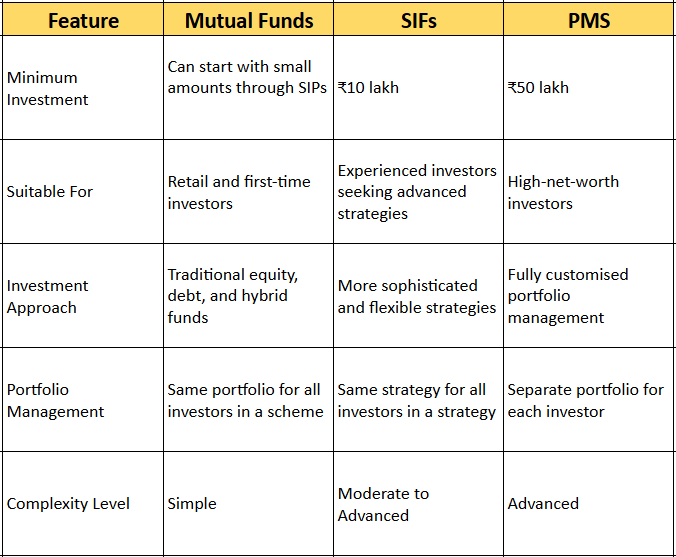
The growth of SIPs brought many investors into mutual funds. Digital onboarding, simplified transactions and goal-based investing helped investors connect financial products with real-life objectives.
SIFs have the potential to become another significant milestone.
If you understand this category early, you may be better positioned to serve investors seeking more advanced investment solutions.
Rather than viewing SIFs as merely another product launch, they can be seen as an opportunity to expand services and deepen client relationships.
The launch of SIFs calls for a diversification and deepening of mutual fund distribution strategies to be better aligned with the client-centricity model.
In fact, mutual fund distribution continues to be one of the promising Business Opportunities for Housewives, retired professionals, and individuals seeking flexible career options.
You do not need to become an expert on SIFs overnight. You do not need to discuss them with every investor. What you do need is awareness. The clients who trusted you with their first SIP are not the same investors they were ten years ago. SIFs may not be suitable for every investor. But understanding them today could help you serve the right investors better tomorrow. And in the mutual fund business, that is often where the next phase of growth begins.
FAQs
1. How Can Mutual Fund Distributors Benefit From SIFs?
SIFs are a great tool for mutual fund distributors to reach the segment of investors who want more sophisticated investment products. They can be used to deepen investor relationships, increase client retention, and also generate new revenue streams within the mutual fund business.
2. What Mutual Fund Distribution Strategies Can Help When Introducing SIFs?
The best mutual fund distribution strategies are aimed at educating investors, rebalancing portfolios and consistent communication.
3. Are there business opportunities for housewives in mutual fund distribution?
Yes. Mutual fund distribution is one of the best business opportunities for housewives who wish to work at their convenience, have a low initial investment, and at the same time be able to create a consistent income source.