Every time the market dips, the standard panic sets in: investors rush to check their apps, headlines talk about volatility, and the temptation to pull money out or pause SIPs takes over.
But if you look past the noise and study what Indian mutual fund investors are actually doing with their money, a very different reality emerges. Let’s look at the recent trend among the new Mutual Fund Investors.
For years, conversations around retail investing in India centered on market timing, short-term momentum, and reactionary redemptions during market drawdowns. However, actual market data between March 2021 and March 2026 shows a structural shift in investor behavior: Indian mutual fund investors are staying invested longer and shifting focus toward compounding.
Alongside this lengthening holding horizon, women investors have emerged as a significant force, driving long-term equity growth through disciplined monthly investments.
The biggest advantage in investing is giving your capital sufficient time to work across market cycles. Recent industry metrics highlight a clear transition away from short-term churn and toward patient capital.
In March 2021, only 7.7% of the total mutual fund industry Assets Under Management (AUM) was held for more than 5 years. By March 2026, that figure expanded to 19.2%.
The change is even more pronounced among Systematic Investment Plan (SIP) accounts. In March 2021, the share of SIP AUM held for more than 5 years stood at 12.3%. By March 2026, it grew to 31.0%. This indicates that nearly one-third of all SIP money in the market has stayed put through varying market conditions for half a decade or more.
Short-term holdings (assets held for less than 1 year) made up 37% of total industry assets in March 2021. By March 2026, this share decreased to 21.1%.
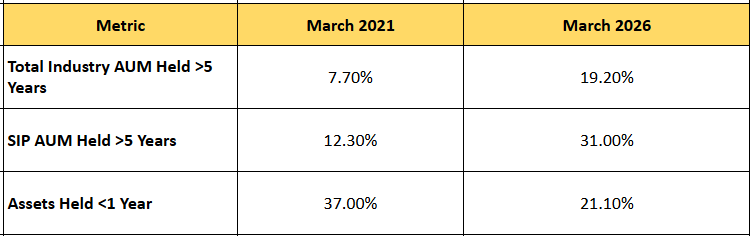
Longer holding periods help absorb market volatility. Staying invested through market corrections allows portfolios to recover alongside broad economic growth without interrupting the compounding cycle.
A major factor shaping this long-term trend is the rapid participation of women in capital markets. Between March 2021 and March 2026, women expanded both their total asset footprint and their allocation toward growth assets.
In March 2021, the mutual fund asset base of women investors stood at ₹5.84 lakh crore. By March 2026, it grew nearly three-fold to reach ₹15.88 lakh crore. Today, women account for 34.5% of the total individual investor market.
The composition of what women invest in has fundamentally changed over this 5-year window:
Systematic investing has been the engine behind this expansion. In March 2021, women held ₹1.26 lakh crore in SIP AUM. By March 2026, this grew nearly four-fold to ₹4.73 lakh crore. SIPs now represent roughly 30% of their total mutual fund portfolios, doubling from 15.2% in 2021.
This commitment to monthly investing has influenced holding timelines. In March 2021, only 5% of women investors held their mutual fund units for longer than 5 years. By March 2026, that number expanded to 24%.
Frequently Asked Questions
1. What Percentage of Indian Mutual Fund Assets are Held for More Than 5 Years?
As of March 2026, 19.2% of the total mutual fund industry AUM is held for more than 5 years, up from 7.7% in March 2021. For SIP accounts specifically, 31.0% of assets have been held for more than 5 years.
2. What is the Current Size of The Women Investor Mutual Fund Market in India?
As of March 2026, women hold ₹15.88 lakh crore in mutual fund assets, representing 34.5% of the individual investor market in India.
3. How has the Asset Allocation of Women Investors Changed Over the Last 5 Years?
Between March 2021 and March 2026, equity allocations among women investors increased from 49% to approximately 64%, while debt allocations fell from 24% to 8%. Hybrid fund allocations remained steady at 18% to 21%.
Source: AMFI, Crisil 2026
Disclaimer: This article is for educational and informational purposes only and should not be construed as investment advice, a recommendation, solicitation or an offer to buy or sell any security or financial product. Mutual fund investments are subject to market risks. Investors should consider their own investment objectives, risk profile, time horizon, liquidity requirements and applicable tax considerations before making investment decisions.