Have you ever looked at a mutual fund’s published factsheet, checked your own portfolio statement, and wondered why the two figures don’t match?
It is a common scenario. This difference does not mean your fund house made an error. This discrepancy between fund returns and investor returns is one of the most discussed points in personal finance. It comes from one distinct factor:
The mathematical difference between how fund performance is reported vs how your money is deployed (CAGR and XIRR). Let’s understand!
A big reason people get confused about their returns is that they measure them the wrong way.
CAGR measures the annual rate at which an investment grows from a single starting value to a single ending value. It assumes profits are reinvested each year.
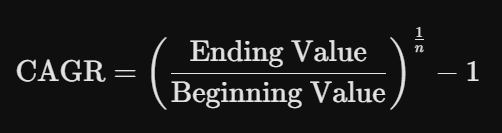
CAGR is useful for evaluating one-time lumpsum investments held without any deposits or withdrawals over n years.
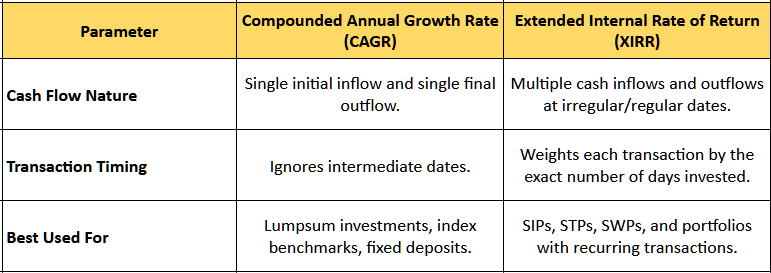
CAGR cannot evaluate Systematic Investment Plans (SIPs). If you invest ₹10,000 every month for five years, your first installment stays invested for 60 months, but your 60th installment stays invested for only 30 days. Applying a single point-to-point CAGR across all those varying timeframes is mathematically invalid. So, when multiple cash flows happen within a time period, XIRR comes into picture.
XIRR shows your yearly return when you invest money on different dates. Unlike a single deposit, it tracks every SIP installment and withdrawal to calculate your true annual gain.
Every time you invest via SIP, buy an additional tranche, receive a dividend payout, or make a partial redemption, XIRR assigns a specific date to that cash flow and calculates the exact annualized rate of return across the entire series.
Consider an investor evaluating a mid-cap mutual fund over a three-year cycle:
The fund delivered nearly 16% annualized return. But the investor walked away with 5.2%. The only reason was because the capital entered the market at the wrong point in the cycle.
Frequently Asked Questions (FAQs)
1. Why is My Mutual Fund Portfolio Return Different from the Fund's 3-Year Return?
The 3-year return on a factsheet is a point-to-point CAGR assuming a single lumpsum deposit on day one. If you are investing via monthly SIPs, your money was deployed across different dates and varying NAVs, resulting in an XIRR that reflects your actual cash flows.
2. Is XIRR Always Lower than CAGR?
No, XIRR is not always lower than CAGR. They serve different purposes: CAGR (Compound Annual Growth Rate) evaluates a single point-to-point investment, whereas XIRR (Extended Internal Rate of Return) accounts for multiple cash flows occurring at different dates, such as an SIP.
3. How Do I Calculate XIRR for My Investments?
Most mutual fund platforms and distributor portals calculate XIRR automatically. You can also calculate it manually in Microsoft Excel or Google Sheets using the =XIRR(values, dates) formula. Enter your investments as negative numbers (since it's an outflow of money), redemptions/current value as positive numbers, and their corresponding transaction dates.
Disclaimer: Mutual fund investments are subject to market risks. Please read all scheme-related documents carefully before investing. Historical performance and point-to-point CAGR metrics are illustrative and do not guarantee future returns.