Before investing money in a mutual fund, most people check its returns, but returns alone do not tell you what the investment may feel like during a bad market. The value of a mutual fund can rise and fall, and the size of those movements depends on what the fund owns.
The Mutual Fund Riskometer gives investors a simple way to see the level of risk attached to a scheme. It does not predict returns or tell you whether a fund will make money. It gives you a broad idea of how much uncertainty comes with the investment.
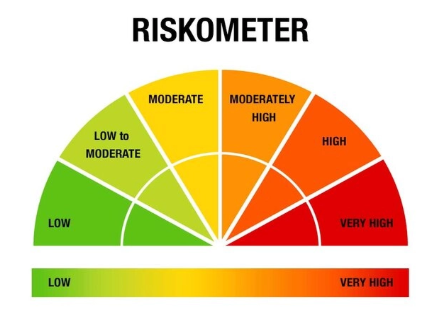
The Riskometer is a six-level scale used to show the risk level of a mutual fund scheme.
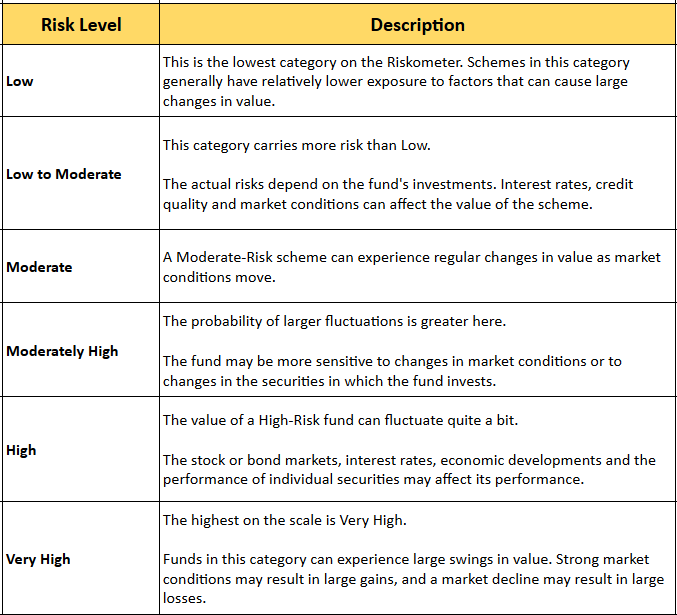
The six categories are:
A fund placed in the Low category generally carries less risk than one placed in the Very High category. That does not make a low-risk fund completely safe. The value of any mutual fund can change, and there is no guaranteed return.
The main purpose of the Riskometer is to make information about risk easier for investors to understand.
Mutual funds are not all alike. An equity fund may invest most of its money into company shares. A debt fund may invest in bonds and money market instruments. A hybrid fund may hold a combination of equity and debt.
The level of risk can also differ between funds that belong to the same category. Their portfolios, investment strategies and exposure to different securities may be quite different.
For a new investor, it is not always easy to spot these differences. The Riskometer provides a quick indication before you start examining the details of a scheme.
It also helps put past returns into perspective. A fund with strong returns may have gone through sharp rises and falls along the way. Knowing the risk level can help an investor understand that performance in a better context.
The Riskometer is based on the risk profile of the scheme and the risk profile of investments in the portfolio.
The classification may be affected by different factors like asset allocation, market volatility, credit quality, interest-rate sensitivity and liquidity. For instance, consider debt funds. The bond types that dominate the fund can affect the fund's level of risk. Likewise, changing interest rates can be the cause of a shift in the market value of debt securities.
For equity funds, the companies and sectors in the portfolio matter.
Funds that are diversified across a range of companies may have a different risk profile to those that have a heavy weighting to a particular sector or type of company. So the fund category alone doesn’t tell the whole story.
Yes. The risk rating can change.
A mutual fund's portfolio can change over time. The fund manager may buy or sell securities, and the risk associated with those securities can change as market conditions change.
Because of this, the Riskometer is reviewed periodically. The rating you see today may not be the same as the rating shown when you originally invested. This is one reason investors should check the current scheme information from time to time.
No. A higher risk rating is not a guarantee of higher returns. This means that the investment can be more volatile.
For example, an equity fund rated Very High-Risk may perform well when the stock market is rising. The same fund can take a big hit when the market is down.
A lower-risk fund might not change as much, but it doesn’t mean it will always give a positive return.
The Riskometer is therefore a measure of risk, not a ranking of funds according to expected returns.
Start by looking at your financial goal.
If you are investing for a short term goal, a large fall in the value of your investment could create a problem. If you are investing for a longer-term goal, you may have more time to deal with market fluctuations.
Your ability to tolerate losses is also important. Think about how you would react if your investment lost 15% or 20% during a market fall. If that would make you sell immediately, a high-risk fund may not be a comfortable choice.
After checking the Riskometer, read the fund's investment objective and look at its portfolio. Check where the money is invested, how concentrated the portfolio is and what charges apply.
Past performance can also be reviewed, but it should be treated as historical information rather than a promise of future results.
The Mutual Fund Riskometer is a useful way to get a quick view of the risk attached to a mutual fund scheme. The six categories make it easier to understand whether a fund sits toward the lower or higher end of the risk scale. Before investing, check the current Riskometer, understand the fund's investments and ask yourself a simple question: Can I handle this level of risk without losing sleep or making a rushed decision?